75 Ball Bingo Skill Game: Why 75-Ball Is the Standard for Skill-Based Bingo
Author: “Zenith Games Editorial” Author_url: “https://www.zenithgames.com/about/”
If you have played any modern skill-based bingo app, you have played a 75 ball bingo skill game — even if you never noticed the format. Bingo Gold Cash (BGC), like most real-money skill bingo titles, runs exclusively on a 75-ball format: a 5×5 card with a free center space and 75 possible called numbers.
The choice is not cosmetic. The 75-ball format packs the card geometry, the pattern system, and the call pace that a fair, skill-tested competition needs. This guide breaks down the format from the grid up, shows you why it became the industry standard, and maps each element to how BGC actually scores a match.
If you are brand new to the game, our Bingo Gold Cash beginner guide covers the onboarding basics. This article is the format-level deep dive: what the 75-ball system is, how it enables identical boards, and how you can use the geometry to daub faster and score higher.
Table of Contents
- What Makes a 75 Ball Bingo Skill Game Different
- The Anatomy of a 75-Ball Card
- The Four Patterns and Route-Choice Skill
- Why 75 Balls Fit a 90-Second Clock
- 75-Ball vs 80-Ball vs 90-Ball: Format Comparison
- Traditional 75-Ball vs Skill-Based 75-Ball
- How the Format Shapes Scoring
- Frequently Asked Questions
What Makes a 75 Ball Bingo Skill Game Different
A 75 ball bingo skill game looks identical to a traditional 75-ball game at first glance. Same card, same column ranges, same patterns. The difference lives in the rule shell around the format.
| Element | Traditional 75-Ball | Skill-Based 75-Ball (BGC) |
|---|---|---|
| Card | 5×5 with free center | 5×5 with free center, identical for all players |
| Ball sequence | Random per room | Fixed, identical for all players |
| Boosters | None or cosmetic | Timed power-ups, identical sequence for all players |
| Winning | First to complete the pattern | Points-based: daub speed + pattern completion + error control |
| Match length | Until someone wins | Fixed 90-second clock |
The format provides the playing field; the rule shell decides whether luck or skill decides the winner. In BGC’s shell, every player in a match sees the same board and the same ball sequence, so the only variable that separates two players is execution — how fast they daub, how clean their errors stay, and how they route through patterns.
That single design decision is why the 75-ball grid became the standard. A 90-ball format (9×3 card, three rows) is wider and slower to scan; an 80-ball format uses a 4×4 grid that does not map cleanly onto the classic B-I-N-G-O columns. The 75-ball card is the one format where grid geometry, pattern math, and game speed all align.
The Anatomy of a 75-Ball Card
The 75-ball card is a 5×5 grid with a free space in the center. Each column maps to one letter of B-I-N-G-O, and each letter owns a fixed number range.
| Column | Letter | Number Range | Cells |
|---|---|---|---|
| 1 | B | 1-15 | 5 |
| 2 | I | 16-30 | 5 |
| 3 | N | 31-45 | 5 (center cell is FREE) |
| 4 | G | 46-60 | 5 |
| 5 | O | 61-75 | 5 |
The center cell — the third cell of the N column — is pre-marked as free. Every pattern that crosses the center (both diagonals and the middle row and column) effectively needs only four live calls to complete, which is why diagonal and center-line finishes happen earlier in a match than edge lines.
For a skill player, the card anatomy matters because of visual bandwidth. Your eyes must track 24 live cells, not 90. With BGC’s 90-second matches and daub scoring from 100 to 140 points per correct daub, the time saved by a compact grid is time spent on anticipation instead of searching.
The 24 live cells split into five neighborhoods by column letter. Experienced players learn the number ranges so tightly that they can glance at a called number — say 52 — and jump straight to the G column without hunting. That column-to-number mapping is a trainable skill, not luck, and it works exactly the same on every identical board. Our bingo card strategy covers how to read and route a 5×5 grid under pressure.
The Four Patterns and Route-Choice Skill
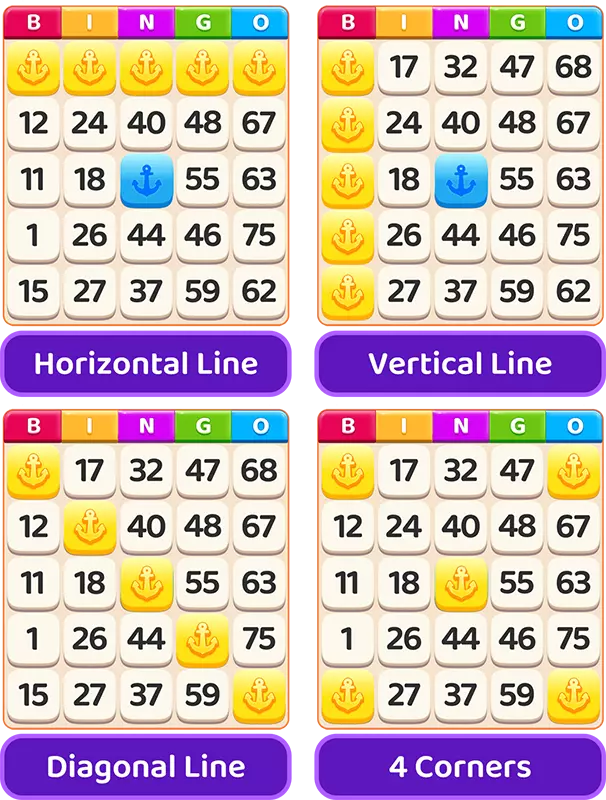
BGC runs four pattern types: five horizontal or vertical lines, two diagonals, and four corners. Each pattern has a different “call cost” — the number of live cells you actually need to fill.
| Pattern | Cells Needed | Free Center Help | Typical Completion Window |
|---|---|---|---|
| Any horizontal line | 5 (4 if it crosses the center) | Yes, for the middle row | Mid-match |
| Any vertical line | 5 (4 for the N column) | Yes, for the N column | Mid-match |
| Diagonal (either) | 4 (center is free) | Yes, always | Early-mid match |
| Four Corners | 4 (no center help) | No | Mid-match |
The pattern system creates the game’s route-choice skill. Because every player daubs the same board in the same order, finishing positions are decided by who completes a pattern first — and, in BGC’s scoring, who daubs the most cells along the way.
Route choice means deciding which pattern you are actually playing for while the balls fall. A diagonal needs four live cells and can finish early, but so can any opponent’s. A Four Corners pattern has no free-center help, yet four corners are spread across the card in a way that is easy to keep in peripheral vision. Players who switch their target pattern mid-match, based on which cells are filling fastest, score more BINGO completions per match than players who lock onto one line.
Multi-BINGO is where the format pays off. Because patterns share cells — a full middle row plus a full diagonal is two patterns with one overlapping cell — a well-placed daub sequence can complete two or more patterns on the same call. BGC’s scoring rewards that with a multi-BINGO multiplier on top of the base 1,000 BINGO points.
Why 75 Balls Fit a 90-Second Clock
BGC matches run 90 seconds. The 75-ball format fits that clock for a concrete reason: the pool of 75 balls is small enough that calls come fast and the match stays readable, yet large enough that no two matches feel identical.
| Format | Ball Pool | Card Size | Scan Load | Typical Match Feel |
|---|---|---|---|---|
| 75-ball | 75 | 5×5 (24 live) | Low | Fast, pattern-driven |
| 80-ball | 80 | 4×4 (16 live) | Lowest | Very fast, but pattern variety is thin |
| 90-ball | 90 | 9×3 (27 live) | High | Slower, line-by-line |
| 75-ball (BGC) | 75 | 5×5 + fixed order | Low | Fast + identical for all players |
A 90-second match with a 75-ball pool means the caller surfaces roughly one ball every two to three seconds. Each call is a decision point: daub fast for 100-140 points, or hesitate and risk falling behind on the same board.
The fixed sequence removes the last luck variable. In a traditional hall, the ball order decides who gets lucky; in BGC, the order is a shared constant. The 90-second clock then measures how quickly you process the shared information. That is the purest definition of a skill game: identical conditions, measured execution.
75-Ball vs 80-Ball vs 90-Ball: Format Comparison
If the 75-ball format is the standard for skill-based play, it helps to see what the alternatives give up. The three active formats differ in card shape, ball pool, and the skill they reward.
| Dimension | 75-Ball | 80-Ball | 90-Ball |
|---|---|---|---|
| Card | 5×5, 24 live cells | 4×4, 16 live cells | 9×3, 27 live cells |
| Ball pool | 75 | 80 | 90 |
| Column letters | B-I-N-G-O | None (numbers only) | None (rows) |
| Patterns | Lines, diagonals, corners | Lines, 2×2 blocks | Lines only |
| Scan speed | Fast | Fastest | Slowest |
| Skill emphasis | Route choice + daub speed | Daub speed | Pattern awareness |
The 80-ball format has the lightest scan load, but its pattern variety is thin, which compresses the skill ceiling. The 90-ball format is the richest in pattern tradition, but its 9×3 layout slows scanning and its three rows are harder to route in parallel. The 75-ball card sits in the middle: enough cells for meaningful pattern overlap, compact enough for fast scanning.
That balance is why BGC and most real-money skill bingo apps standardize on 75-ball. If you understand the card geometry and pattern math, the format stops being furniture and becomes a lever.
Traditional 75-Ball vs Skill-Based 75-Ball
The same 75-ball grid powers two very different games. The format is shared; the competition model is not.
| Comparison | Traditional Hall | BGC Skill-Based |
|---|---|---|
| Board | Random per player | Identical for all players |
| Ball order | Random per game | Fixed per game, shared |
| Booster tools | None | Wild Daub / Pick-A-Ball / Double Score / Bonus Time |
| Win condition | First to complete | Highest points at the 90-second mark |
| Rake model | House edge per game | Documented 10-20% rake per entry |
| Withdrawal | Varies by venue | PayPal only, $5 minimum, 1-3 business days |
In a traditional hall, your card is dealt to you and your ball sequence is luck. Two players can see completely different information, which makes the game a lottery dressed in a grid. The skill-based shell removes both variables: same board, same calls, same booster sequence.
What remains is the same skill set every 75-ball player already trains — scanning speed, daub accuracy, and pattern routing — now measured against other players under identical conditions. That is the core argument for why a 75 ball bingo skill game rewards practice in a way a traditional game cannot.
If you want the rules-level detail, our skill-based bingo rules guide walks through the full rule set, and our bingo odds and probability guide explains how pattern math changes when the board is shared.
How the Format Shapes Scoring
BGC’s scoring table is built around the 75-ball grid. Each element of the format maps to a scoring line.
| Action | Points | Format Connection |
|---|---|---|
| Correct daub | 100-140 | Speed-weighted: faster daubs score higher |
| BINGO (first pattern) | 1,000 | Pattern completion on shared board |
| Multi-BINGO | Multiplier | Overlapping patterns completed together |
| Full House | 10,000 | All 24 live cells |
| Error (wrong daub) | -25 to -100 | Accuracy penalty |
The 100-140 daub range is the format’s heartbeat. Because the card is compact, a prepared player can daub within a fraction of a second of a call. The scoring system converts that reaction edge into points, which is why two players on the same board can finish with very different scores.
Full House (10,000 points) requires filling all 24 live cells. In a 90-second match that is a rare, high-risk play: it means ignoring pattern completion early and daubing everything. The 75-ball grid makes it theoretically possible within the clock; the 90-second limit makes it a gamble.
Accuracy matters as much as speed. A wrong daub costs -25 points, and an error on a pattern cell costs -100. On a shared board, an error is pure self-inflicted damage — every other player simply continues. Our bingo scoring strategy guide breaks down how to balance the 100-140 speed range against the error penalty, and our bingo daub guide covers the physical mechanics of accurate tapping.
Frequently Asked Questions
Is 75-ball bingo a skill game or a luck game?
The format itself is neutral; the rule shell decides. In traditional 75-ball, random boards and random ball orders make luck dominant. In a skill-based implementation like BGC, the identical board and fixed ball sequence mean every player processes the same information, so daub speed, accuracy, and pattern routing decide the outcome.
Why is 75-ball the standard for skill-based bingo apps?
The 5×5 grid with a free center balances scan speed and pattern depth. It has enough cells (24 live) for meaningful pattern overlap and multi-BINGO routes, yet is compact enough for fast scanning under a short clock. The B-I-N-G-O columns also create trainable number-to-column mappings that reward practice.
What are the four patterns in a 75-ball Bingo Gold Cash game?
BGC runs four pattern types: five horizontal or vertical lines, two diagonals, and four corners. Diagonals need only four live calls because the center is free, so they tend to complete earlier. Overlapping patterns can complete together as a multi-BINGO with a scoring multiplier.
How many balls are in a 75-ball bingo game?
There are 75 possible balls, split into five ranges of 15: B (1-15), I (16-30), N (31-45), G (46-60), and O (61-75). A match calls a subset in sequence. In BGC the sequence is identical for every player in the room.
Does a bigger card mean more skill?
Not by itself. A 90-ball card has more cells but a slower scan, which reduces the speed component. A 4×4 80-ball card scans fastest but has thin pattern variety. The 75-ball card’s middle position — 24 live cells, four pattern families, fast scanning — is what makes it the skill-format standard.
How does the free center space affect strategy?
The free center completes every pattern that crosses it: both diagonals, the middle row, and the N column each effectively need four live calls instead of five. Route-choice players use the free center to aim for early diagonals while keeping corner patterns as a fallback.
Can a beginner compete in a 75-ball skill game?
Yes, because the format is identical for everyone. Beginners lose the speed and route-choice battle, not the information battle. Our skill bingo guide explains why identical conditions make outcomes skill-driven; once you drill the column number ranges, scanning becomes automatic and daub speed follows.
⬇️ Download Bingo Gold Cash — Free on iOS & Android
Related Link: