Bingo Card Strategy in 2026: Why Traditional Card Selection Is Dead (And What Powerful Moves Actually Wins)
For decades, the first thing every bingo player learned was “pick the right card.” That advice is now obsolete.
If you search “bingo card strategy” today, you will find thousands of words on Granville’s theory, Tippett’s principle, and the art of selecting cards with balanced number distributions. These methods were built for a world where every player holds a different card. Where your odds are literally determined by which piece of paper you pick up.
That world no longer exists in skill-based bingo — and the most successful players have already adapted.
Bingo Gold Cash (BGC) runs on a fundamentally different architecture: every player in a match receives the exact same 5×5 bingo card, the same 75-ball sequence, and the same power-up drops in the same order. There is no card selection. There is no “better board.” There is only one question:
Are you faster and smarter than the players next to you?
This article explains why everything you have read about bingo card strategy is wrong for modern skill-based games — and what you should be focusing on instead.
The Traditional Bingo Card Obsession (And Why It Made Sense — Once)
To understand why card strategy no longer applies, you need to know what it was solving.
Granville’s Theory
Joseph Granville, a financial writer and bingo enthusiast, published a theory in the 1970s arguing that winning bingo cards have a statistically “balanced” distribution of numbers across columns. His system rated cards by analyzing the mix of high/low, odd/even, and numbers ending in specific digits. The assumption: balanced cards hit bingo sooner because balls are drawn randomly from a uniform distribution.
Tippett’s Principle
L.H.C. Tippett, a British statistician, proposed that longer games favor cards with numbers clustered toward the median (38 for 75-ball), while shorter games favor cards with numbers near the extremes (1 and 75). The logic was sound: as more balls are drawn, the sample mean approaches the population median.
Why Both Are Irrelevant in BGC
Both theories share a single, fatal assumption for modern skill-based play: your card is different from everyone else’s card. When you are the only person holding a specific 5×5 grid, card quality matters because no one else can complete your patterns. In BGC, every player sees the same numbers in the same positions. If a ball drops at B-7, everyone marks the same square — or misses it.
Card selection strategy is a dead concept. What replaces it is something far more interesting.
The Skill-Based Revolution: What Happens When Everyone Has the Same Card
BGC’s architecture creates a perfectly controlled competitive environment. Here is what that means in practice:
| Dimension | Traditional Bingo | BGC Skill-Based Bingo |
|---|---|---|
| Card | Every player has a different card | All players share identical board |
| Ball Sequence | Random per game; may differ across cards | Identical for all players in a match |
| Power-Up Sequence | Typically absent | Identical drops, same timing |
| Win Condition | Luck of the card draw | Speed + strategy execution |
| Player Agency | Near zero — you wait for numbers | High — every millisecond and decision matters |
This is not a minor tweak to bingo mechanics. It is a complete inversion of the skill-to-luck ratio. In traditional bingo, your card does 90% of the work and your attention does 10%. In BGC, your execution does 100% of the work — the card is just the shared playing field.
What Actually Matters: The 5 Real Determinants of Winning
If you cannot gain an edge through card selection, where does the edge come from? Five factors, ranked by impact:
1. Pattern Priority — Choosing the Fastest Route to BINGO
BGC uses exactly four pattern types: Horizontal Line (5 possible), Vertical Line (5 possible), Diagonal Line (2 possible), and Four Corners (1 possible).
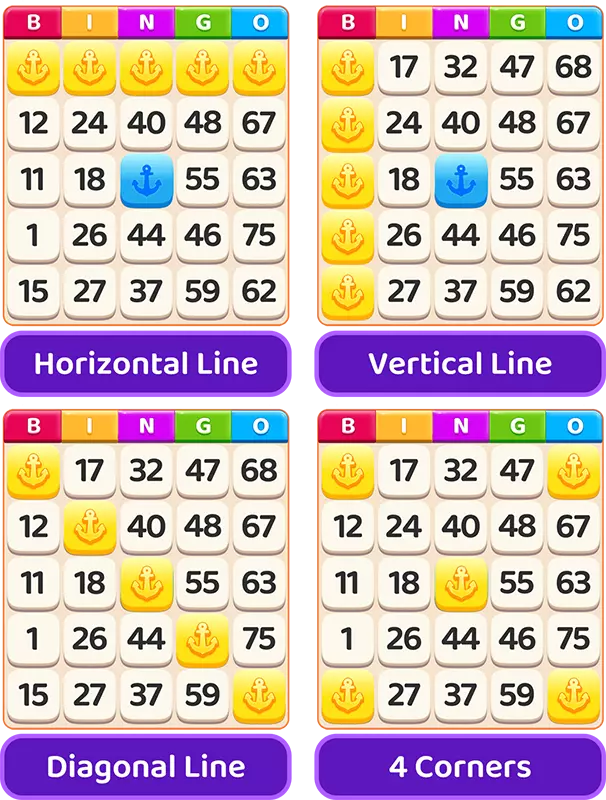
Because every player sees the same board, pattern priority becomes a real-time optimization problem. The winning approach:
- Scan the board before the first ball drops — identify which patterns are closest to completion based on the static board layout. A column with 3 numbers already in the called range gets priority attention.
- Track completion percentages — as balls drop, mentally update which patterns are advancing fastest. The first pattern to reach 4/5 numbers should claim your focus.
- Never lock onto one pattern too early — the ball sequence is unpredictable. A pattern at 3/5 on ball 15 might stall at 3/5 until ball 60, while another pattern accelerates late. Stay flexible.
2. Daub Speed — The Raw Mechanical Edge
In BGC, your daub score ranges from 100 to 140 points depending on how fast you mark a called number after it appears. This is not a trivial difference: a player averaging 135 points per daub across a match gains roughly 30-40% more daub score than a player averaging 105. That gap alone can swing leaderboard positions.
The skill is deceptively simple but brutally hard to optimize:
- Your eyes must track the ball announcement zone while your thumb hovers over the board
- You must recognize the number’s column (B/I/N/G/O) and row simultaneously
- Your reaction time from announcement → daub must stay under approximately 0.8 seconds to consistently hit the 130+ range
This is the single most practice-sensitive skill in BGC. No theory helps. Drills help.
3. Power-Up Timing — Converting Tools Into Points
BGC offers four power-ups: Wild Daub (mark any square), Pick-A-Ball (call the ball you need), Double Score (2× points for 10 seconds), and Bonus Time (10 extra seconds with 3 additional balls).
The strategic layer is not what each power-up does — it is when you activate it:
- Wild Daub is most valuable when one specific square is blocking a pattern completion. Activating it without a clear target wastes the power-up.
- Pick-A-Ball pairs best with Double Score or near the end of a match when one number separates you from a BINGO.
- Double Score combined with Bonus Time creates a high-scoring window. Activate Double Score first, then Bonus Time immediately after, to maximize the 10 seconds of 2× scoring.
- Never hold all three power-up slots full — unused power-ups are lost scoring potential. A power-up held for 30 seconds without use is strictly worse than one deployed sub-optimally.
4. Multi-BINGO Awareness — The Hidden Score Multiplier
When you hit the BINGO button after completing multiple patterns simultaneously, BGC applies a score multiplier. The more patterns you complete before pressing BINGO, the larger your bonus.
This creates a strategic tension: call BINGO immediately for a guaranteed 1,000 points, or delay by 1-3 seconds to daub additional numbers and potentially complete 2-3 patterns at once, earning 2,000-3,000+ points. The risk is that another player calls BINGO first and claims the pattern before you.
How to build Multi-BINGO awareness:
- Before each match, study the board for overlapping pattern opportunities. A horizontal line and vertical line that intersect create a natural Multi-BINGO window.
- During play, when you approach 4/5 on two or more patterns simultaneously, consciously delay the BINGO press by 1-2 daubs to check for completions.
- The Four Corners pattern overlaps with two horizontal lines (Row 1 and Row 5) and two vertical lines (Column B and Column O) — always mentally flag Four Corners progress because it doubles as progress on four other patterns.
5. Error Avoidance — The Silent Rank Killer
Every error daub costs you -25 points. Every erroneous BINGO button press costs -100 points. In a match where top positions are often separated by 200-500 points, three errors can drop you from 2nd place to 10th.
Common error sources:
- Speed-induced mis-taps — tapping a square adjacent to the correct number when rushing. Solution: prioritize accuracy in low-stakes practice. Speed builds naturally; accuracy requires intentional focus.
- Phantom BINGO presses — hitting the BINGO button when a pattern is at 4/5, not 5/5. This often happens when adrenaline peaks near match end. Solution: build a 0.5-second mental “confirm pattern” habit before every BINGO press.
- Distracted daubing — losing focus during the middle portion of a 90-second match when no patterns are near completion. Solution: treat every daub as a scoring opportunity (100-140 points), not just a path to BINGO.
Reading Your Board Like a Pro: Quick Scanning for the 5×5 Grid
Efficient board scanning is a trainable skill. Here is a systematic approach for the BGC 75-ball 5×5 grid:
The Diagonal Baseline Scan
Before the first ball, run your eyes along both diagonals. These are priority patterns because only two diagonal opportunities exist, compared to five horizontal and five vertical. If either diagonal shows early numbers in the called sequence, you have a rare and valuable pattern lead.
The Free Space Anchor
The center square (N-column, row 3) is permanently marked as “FREE.” This means:
- The middle horizontal row (Row 3) starts at 1/5 completion
- The middle vertical column (Column N) starts at 1/5 completion
- Both diagonals that pass through the center start at 1/5 completion
In practical terms: patterns that include the FREE space require only 4 called numbers instead of 5. Prioritize tracking patterns that cross the center.
The Column Discipline
BGC’s 75-ball format assigns number ranges to each column:
- B column: 1-15
- I column: 16-30
- N column: 31-45 (center is FREE)
- G column: 46-60
- O column: 61-75
When a ball is called, your brain should process two pieces of information simultaneously: (1) which column the number belongs to, and (2) whether that column has active pattern opportunities. This dual processing cuts your daub response time significantly.
Card Layout and Multi-BINGO: How Pattern Overlap Creates Scoring Windows
The layout of a static board creates fixed pattern overlap zones. Understanding these zones before the match begins gives you a Multi-BINGO roadmap:
| Overlap Zone | Patterns Involved | Multi-BINGO Potential |
|---|---|---|
| Row 1 + Column B | Horizontal line 1, Vertical line B | 2 patterns — common but fast |
| Row 3 + Column N | Horizontal center, Vertical center, both diagonals | Up to 4 patterns — rare, highest-value |
| Row 1 + Row 5 + Column B + Column O | Two horizontals, two verticals, Four Corners | Up to 5 patterns — extremely rare, requires perfect number sequence |
| Diagonal (TL→BR) + Row 3 | One diagonal, center horizontal | 2 patterns — moderate frequency |
The center intersection (Row 3, Column N, FREE space) is the holy grail: it touches four patterns simultaneously. When late-game numbers fill the center cross, the Multi-BINGO potential jumps dramatically. Players who recognize this 3-5 seconds before the critical moment consistently outperform those who react only when the BINGO button lights up.
Frequently Asked Questions
Do I need to pick the right bingo card in BGC?
No. BGC assigns the identical 5×5 75-ball card to every player in a match. Card selection does not exist as a strategy — your performance is determined entirely by daub speed, power-up timing, pattern recognition, and error management.
What is the best bingo card strategy for skill-based games?
In skill-based bingo platforms like BGC, traditional card selection strategies (Granville, Tippett) are irrelevant. The best strategy shifts to: (1) pre-match board scanning to identify pattern priorities, (2) optimizing daub reaction time for the 100-140 point range, (3) timing power-up activation for maximum scoring windows, (4) tracking Multi-BINGO opportunities through pattern overlaps.
Why don’t traditional bingo card theories work anymore?
Traditional theories like Granville’s and Tippett’s assume every player holds a unique card, making card quality a competitive differentiator. Skill-based bingo platforms eliminate this variable entirely by giving all players the same board. The competitive differentiator shifts from card quality to player execution.
How many patterns can I complete on a single bingo card?
In BGC’s 75-ball format with a 5×5 grid, there are 13 possible pattern completions: 5 horizontal lines, 5 vertical lines, 2 diagonal lines, and 1 Four Corners. Players can complete multiple patterns simultaneously for a Multi-BINGO score multiplier.
What is Multi-BINGO and how does it affect my score?
Multi-BINGO occurs when you complete two or more patterns before pressing the BINGO button. BGC applies a score multiplier that increases with the number of simultaneous completions. A single BINGO awards 1,000 points; a double BINGO can award 2,000+ points; a triple or higher multiplies further. The strategic trade-off is delaying your BINGO press for more completions versus the risk of another player calling first.
The Bottom Line
The bingo card strategy conversation has moved on. For decades, players obsessed over number distributions, balanced columns, and the perfect card selection method — because in a world of unique cards, your piece of paper determined your fate.
That world is gone.
In BGC’s skill-based architecture, your results are determined by how well you execute, not which card you hold. The five factors that actually matter — pattern priority, daub speed, power-up timing, Multi-BINGO awareness, and error avoidance — are all trainable. None require luck. None depend on the card you were dealt.
If you are still Googling “how to pick a winning bingo card” in 2026, you are optimizing a variable that no longer exists. The players passing you on the leaderboard figured this out months ago. They stopped worrying about card quality and started drilling daub speed, studying pattern overlap, and timing their power-ups like a chess clock.
The card is the same for everyone. The difference is you.
⬇️ Download Bingo Gold Cash — Free on iOS & Android
Internal Links:
- How skill-based bingo changes card strategy
- Why card selection doesn’t matter anymore
- Identical board system
- Bingo card reading techniques
- Board scanning strategy
- Granville theory vs skill-based play
- Pattern overlap and Multi-BINGO
- Board reading mastery