How to Win at Bingo: Master Patterns, Power-Ups & Scoring in Bingo Gold Cash (2026)
Table of Contents
- Why Bingo Gold Cash Is a Skill Game, Not a Luck Game
- The 75-Ball Card Anatomy
- All 4 Bingo Patterns Explained
- Power-Ups: When and How to Use Each One
- Scoring System: Every Point Matters
- The 90-Second Round: A Phase-by-Phase Breakdown
- Advanced Winning Strategies
- Common Mistakes That Cost You Wins
- FAQ
- Next Steps
1. Why Bingo Gold Cash Is a Skill Game, Not a Luck Game
Most people assume bingo is a lottery with a card. In Bingo Gold Cash, that assumption will cost you money.
Here’s what actually happens in every competitive round:
- Everyone gets the exact same 5×5 board — identical numbers in identical positions
- Everyone hears the same ball sequence — the same call order at the same intervals
- Everyone receives the same booster drops — power-ups appear at identical moments for all players

When randomness is a constant shared equally by all players, the only differentiating factor left is you — your reaction speed, your pattern recognition, and your power-up decisions.
The top 10% of players don’t win because they got lucky draws. They win because they daub faster, spot patterns earlier, and deploy power-ups at the right moment. Those are trainable skills.
Key Insight: In a traditional bingo hall, you compete against a random number generator. In Bingo Gold Cash, you compete against other players’ reflexes and spatial awareness. That distinction changes everything about how you should prepare.
2. The 75-Ball Card Anatomy
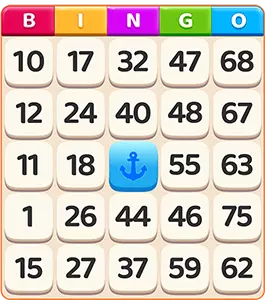
Bingo Gold Cash uses the 75-ball format — the standard North American competitive variant.
Column Ranges
| Column | Letter | Number Range |
|---|---|---|
| 1 | B | 1 – 15 |
| 2 | I | 16 – 30 |
| 3 | N | 31 – 45 |
| 4 | G | 46 – 60 |
| 5 | O | 61 – 75 |
The FREE Space
The center cell (Row 3, N column) is a FREE space — automatically marked at round start, counts toward any pattern that crosses it.
Why this matters strategically: The N column and both diagonals all pass through the FREE space, meaning these patterns start every round already 20% complete. Your pre-scan should identify which of these paths needs the fewest remaining numbers to complete.
3. All 4 Bingo Patterns Explained
Bingo Gold Cash supports exactly 4 pattern types across all game modes. No letter patterns, no picture patterns — just these four.
Pattern 1: Horizontal Line — 5 Possible Completions
Difficulty: ★☆☆ (Easiest)
Bingo Points: 1,000
How to complete: Mark all 5 cells across any single row.
Row 3 (the middle row) contains the FREE space, so it requires only 4 called numbers to complete — making it the statistically fastest horizontal line to hit.
Tactical note: In Multi-Bingo rounds, scan for rows where 2–3 cells are already marked early. Rows that share numbers with your other active pattern targets are the priority.
Pattern 2: Vertical Line — 5 Possible Completions
Difficulty: ★☆☆ (Easiest)
Bingo Points: 1,000
How to complete: Mark all 5 cells down any single column.
The N column (column 3) contains the FREE space and requires only 4 called numbers to complete — making it the fastest vertical target alongside the middle row.
Tactical note: If your card has a cluster of low numbers in the B column or high numbers in the O column, vertical lines in those columns may complete faster than expected. Always audit all 5 columns during your opening pre-scan.
Pattern 3: Diagonal Line — 2 Possible Completions
Difficulty: ★★☆ (Easy)
Bingo Points: 1,000
How to complete: Mark all 5 cells along either diagonal, corner to corner.
Both diagonals pass through the FREE space at the center cell. Each diagonal therefore begins the round already 20% complete, needing only 4 called numbers.
Tactical note: Diagonals are often decided in the final 15 seconds of a round. If you’re tracking both diagonals simultaneously, a single called number can complete either one — keep both on your radar throughout the round.
Pattern 4: Four Corners — 1 Possible Completion
Difficulty: ★★☆ (Easy)
Bingo Points: 1,000
How to complete: Mark all 4 corner cells — B1, B5, O1, O5.
The four corners are always located in the B and O columns. They do not benefit from the FREE space. Track all four corner numbers from the opening call.
Tactical note: Four Corners requires exactly 4 specific numbers. If two or more of your corner numbers are called within the first 30 seconds, prioritize this pattern — it becomes a faster path than waiting for a full row or column.
Multi-Bingo: The Real Score Multiplier
Completing multiple patterns in a single round stacks bonuses far beyond single-pattern play.
| Patterns Completed | Base Bingo Points | Multi-Bingo Bonus |
|---|---|---|
| 1 Bingo | 1,000 | — |
| 2 Bingos | 2,000 | +100 |
| 3 Bingos | 3,000 | +300 |
| Full House (all 13) | 13,000 | +7,800 + 10,000 bonus |
Total possible from Full House: 13,000 + 7,800 + 10,000 = 30,800 points
A Full House requires completing all 13 possible patterns: 5 horizontal + 5 vertical + 2 diagonal + 1 four corners.
Pro Tip: Once you complete any pattern, tap BINGO immediately — then return to daubing for additional bingo completions. Don’t wait. Early BINGO locks in 1,000 points; every subsequent BINGO adds another 1,000 plus growing bonus multipliers.
4. Power-Ups: When and How to Use Each One
Power-ups drop automatically when your Booster Gauge fills — and the gauge fills faster when you daub quickly. You can hold up to 3 power-ups at a time.
Speed isn’t just about daub points. It’s also about earning power-ups before your opponents do.
Wild Daub
Effect: Marks any number on your card, whether called or not.
Best use case: You need a specific corner number (Four Corners) or a diagonal number that hasn’t been called yet.
Scenario: You need G-52 to complete Four Corners.
G-52 hasn't been called after 60 seconds.
→ Activate Wild Daub → G-52 is marked → BINGO.
Avoid using it on: Numbers that are statistically likely to be called soon, or cells not critical to your active patterns.
Pick-A-Ball
Effect: Forces your chosen ball to be called next.
Best use case: You’re 1–2 numbers away from a BINGO with under 20 seconds remaining.
Scenario: You need O-68 to complete a vertical line.
10 seconds left, O-68 hasn't appeared.
→ Activate Pick-A-Ball → O-68 is called → +1,000 points.
Best for comeback plays: If you’re trailing on the leaderboard in the final 30 seconds, Pick-A-Ball is your most reliable swing tool.
Double Score
Effect: All points earned are doubled for 10 seconds.
Best use case: You’re about to complete a pattern, or your Booster Gauge is near full and a quick daub sequence is incoming.
Scenario: 1 number away from BINGO, Booster Gauge at 80%.
→ Activate Double Score → Complete BINGO in doubled window
→ 1,000 base Bingo points × 2 = 2,000 points.
Stacking tip: Using Double Score immediately before a Pick-A-Ball activation maximizes the scoring window. Plan the sequence, not the individual power-up.
Bonus Time
Effect: Adds 10 seconds to the round (equivalent to approximately 3 extra ball calls).
Best use case: Multiple patterns near completion with under 15 seconds on the clock.
Scenario: 10 seconds left, 2 numbers away from Full House.
→ Activate Bonus Time → 3 extra balls called
→ Full House completed → +10,000 bonus points.
Save it for high-value moments: Bonus Time is most valuable when Full House or a 3+ Multi-Bingo is within reach. Using it for a single 1,000-point BINGO wastes its potential.
Power-Up Decision Matrix
| Situation | Recommended Power-Up |
|---|---|
| 1 number away from BINGO, 10 seconds left | Pick-A-Ball |
| Leading the leaderboard, BINGO incoming | Double Score |
| Trailing badly, multiple patterns near complete | Bonus Time |
| Corner or diagonal number missing | Wild Daub |
| Full House possible with time extension | Bonus Time |
5. Scoring System: Every Point Matters
Base Point Values
| Action | Points |
|---|---|
| Correct daub — instant (< 0.8s) | +140 |
| Correct daub — fast (0.8–1.2s) | +130 |
| Correct daub — normal (1.2–1.5s) | +120 |
| Correct daub — slow (> 3s) | +100 |
| Incorrect daub | –25 |
| BINGO completed | +1,000 |
| Multi-Bingo bonus (scales with count) | +100 to +7,800 |
| Full House bonus | +10,000 |
| Wrong BINGO press | –100 |
Why Daub Speed Compounds
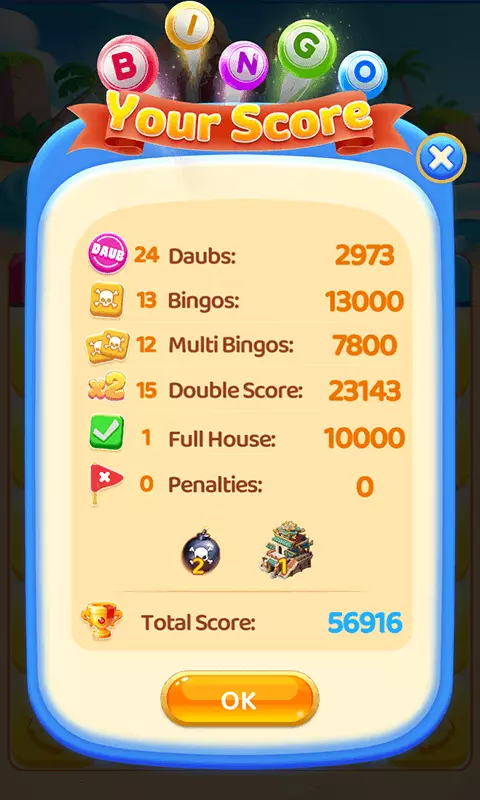
A typical round of 75-ball bingo calls approximately 24–30 numbers. If you consistently daub at 140 points versus 100 points per mark, that’s +40 points per daub — across 24 daubs, that’s +960 points per round from speed alone.
Speed also fills the Booster Gauge faster, meaning earlier power-up access. The compounding advantage of consistent fast daubing is one of the clearest separators between average and elite players.
Error Cost Analysis
A single wrong BINGO press (–100 points) requires completing an additional BINGO just to recover. A wrong daub (–25 points) costs about 18% of your maximum daub score. In a competitive room with 5–80 players, two or three errors can drop you out of the prize positions entirely.
Rule of thumb: Accuracy before speed. A clean 120-point daub is worth more than a 140-point daub followed by a –25 error.
6. The 90-Second Round: A Phase-by-Phase Breakdown
Every Bingo Gold Cash round lasts exactly 90 seconds. Structuring your focus by phase prevents panic decisions and wasted power-ups.
Round Phases
| Time | Phase | Primary Focus |
|---|---|---|
| 0–20 sec | Opening | Pre-scan all patterns; identify fastest paths |
| 20–50 sec | Mid-Game | Commit to 2–3 active patterns; daub with precision |
| 50–75 sec | Late Game | Execute on nearest completions; hold power-ups |
| 75–90 sec | Final Push | Deploy power-ups if within reach of BINGO or Full House |
Leaderboard-Based Adjustments
If leading: Play conservatively. Daub cleanly, complete patterns without errors, hold power-ups as insurance. First place in Daily Match rooms pays 2.4× entry — protect the lead.
If trailing: Switch to aggressive mode. Use Wild Daub or Pick-A-Ball to force BINGO completions. Target Multi-Bingo paths — closing a 2,100-point gap requires two BINGOs, not one.
If tied: Speed decides. Double Score combined with back-to-back fast daubs (140 pts each) can swing 500+ points in 10 seconds.
7. Advanced Winning Strategies
Strategy 1: The Pre-Scan Routine
Use the countdown period before round start to audit your card:
- Locate the FREE space center cell
- Identify which rows, columns, and diagonals have the most pre-existing marks
- Note your corner numbers (B1, B5, O1, O5)
- Rank your top 3 pattern targets by fewest numbers needed
This 5-second investment eliminates the mid-round confusion that causes error daubs.
Strategy 2: Simultaneous Pattern Tracking
Never fixate on a single pattern. The fastest players track all active patterns in parallel.
Maintain these four active tracks at all times:
- Row 3 (FREE space row — needs 4 numbers)
- N column (FREE space column — needs 4 numbers)
- Both diagonals (each needs 4 numbers)
When a number is called, instantly evaluate: “Does this advance any of my four active tracks?”
Strategy 3: The Instant BINGO Trigger
The moment any pattern is complete:
- Stop daubing immediately
- Verify the pattern visually (count marked cells)
- Tap BINGO without hesitation
- Return to daubing for Multi-Bingo
Hesitating costs you the early-BINGO timing advantage. In a room with 20+ players, a 1-second delay means 2–3 other players may press BINGO first, affecting Multi-Bingo bonus allocation.
Strategy 4: Power-Up Sequencing
Individual power-ups are powerful. Sequenced combinations are match-winning:
- Double Score → fast daub burst: Every daub in the window scores 280 points
- Pick-A-Ball → Double Score active: Complete the forced BINGO during the doubled window → 2,000 points
- Bonus Time → Full House within reach: 3 extra balls at 10,000-point bonus potential
Saving two power-ups for a coordinated sequence in the final 20 seconds frequently produces 3,000–5,000 point swings.
Strategy 5: Error Prevention Protocol
Before every daub:
- Hear the letter (B, I, N, G, O)
- Locate the correct column
- Confirm the number matches
- Tap only that cell
Before pressing BINGO:
- Count the marked cells in the target pattern
- Confirm the shape matches the required pattern
- Verify FREE space is included where applicable
- Only then press
The 0.3-second verification costs nothing when you’re right and saves –100 points when you would have been wrong.
Strategy 6: Room Selection by Skill Level
Match your room choice to your current skill tier:
| Skill Level | Recommended Room | Entry | Reasoning |
|---|---|---|---|
| Beginner | Bonus Video / Gems Video | Free | Practice patterns & power-ups with zero risk |
| Developing | Daily Match | $1.00 | Small field (top 4 pay), calibrate your accuracy |
| Intermediate | Bingo Match | $2.50 | 5 winners, sustained 3–6 returns if consistent |
| Advanced | Cash Party / Cash Skies | $5–$10 | Deeper field, higher variance, top returns |
8. Common Mistakes That Cost You Wins
Mistake 1: Speed at the Expense of Accuracy
A 140-point daub followed by a –25 error nets +115. A 120-point clean daub nets +120. Errors compound; discipline compounds too.
Mistake 2: Single-Pattern Tunnel Vision
Completing one BINGO scores 1,000 points. Completing two BINGOs scores 2,100 points. If a second pattern is 1–2 numbers away after your first BINGO, evaluate whether waiting for Multi-Bingo is worth the extra time exposure.
Mistake 3: Using Power-Ups Too Early
Pick-A-Ball used with 45+ seconds remaining and 10 balls yet to be called is nearly always wasted. The same ball might have been called naturally. Power-ups earn their value in the final 30 seconds.
Mistake 4: Forgetting Bonus Time Potential
Full House is worth 10,000 points — 10× a standard BINGO. If you’re 1–2 numbers from Full House with time running out, Bonus Time pays for itself 10 times over. Don’t hoard it for smaller opportunities.
Mistake 5: Ignoring the Leaderboard Until the End
Check the leaderboard at the 45-second mark, not the 80-second mark. An early leaderboard read lets you make informed power-up decisions — aggressive or conservative — with enough round remaining to act.
9. FAQ
What makes Bingo Gold Cash a skill game?
Every player in a Bingo Gold Cash room receives the exact same card, the same ball sequence, and the same power-up drops. Random luck is distributed equally, so the only variable affecting outcomes is each player’s daubing speed, pattern recognition, and power-up timing.
How do I maximize my score per round?
Focus on four levers: (1) daub within 0.8 seconds for +140 per mark, (2) hit BINGO immediately upon pattern completion for +1,000, (3) pursue Multi-Bingo paths for stacking bonuses, and (4) avoid errors that carry –25 and –100 penalties.
When should I use each power-up?
Wild Daub: missing a corner or diagonal number. Pick-A-Ball: 1–2 numbers from BINGO in the final 20 seconds. Double Score: immediately before a BINGO completion. Bonus Time: Full House or 3+ Multi-Bingo within 2 numbers in the final 15 seconds.
How do I avoid wrong daubs?
Use the “hear-locate-confirm-tap” method: hear the letter, find the column, confirm the number matches, then tap. Never pre-tap in anticipation of a call.
Which pattern should I target first?
Row 3 (middle horizontal) or the N column (center vertical) both complete in just 4 called numbers due to the FREE space. Starting your pre-scan focused on these two paths gives you the quickest route to your first BINGO.
How can I compete against experienced players?
Consistency beats aggression at every skill level. Experienced players lose rounds through errors and poor power-up timing as much as through bad luck. If you can maintain zero errors and deploy power-ups in the final 30 seconds, you’re playing a higher-EV game than most opponents.
Can I practice without spending money?
Yes. Bingo Gold Cash offers free daily tournaments (Bonus Video and Gems Video rooms) where all patterns and power-ups work exactly as in paid rooms. Use these to train the pre-scan routine and the instant BINGO trigger before entering cash competition.
How many power-ups can I hold at once?
You can hold up to 3 power-ups simultaneously. Prioritize filling your gauge early in the round through fast daubing — early power-up access is a competitive advantage.
10. Next Steps
Learning how to win at bingo in Bingo Gold Cash comes down to consistent execution across three areas: clean daubing, immediate BINGO recognition, and smart power-up deployment.
Here’s a structured practice path:
| Week | Focus | Success Metric |
|---|---|---|
| Week 1 | Zero-error daubing in free rooms | < 1 error per round on average |
| Week 2 | Instant BINGO trigger — no hesitation | BINGO pressed within 0.5 seconds of completion |
| Week 3 | Multi-Bingo targeting | Average 1.5+ BINGOs per round |
| Week 4 | Power-up sequencing in $1 Daily Match | Positive ROI across 20 rounds |
Once you’re consistently hitting 130+ daub averages with zero wrong-BINGO presses, enter the $1 Daily Match rooms. The top 4 players win — and at that level, four clean rounds per session generate measurable returns.
Ready to apply these strategies?
Start with the free Bonus Video room. No risk, full mechanics, and immediate feedback on your daub speed and pattern recognition.
👉 Download Bingo Gold Cash → zenithgames.com/download
Continue Reading
| Article | What You’ll Learn |
|---|---|
| Bingo Complete Guide 2026: Rules, Card Anatomy & How to Play | Card layout, 4 patterns, 6-step round walkthrough |
| Bingo Strategy Guide 2026: Power-Ups, Scoring & How to Win | Advanced scoring mechanics, power-up timing frameworks |
| Bingo Gold Cash Rooms & Real Money Withdrawals | Room selection EV, PayPal cashout process, trust verification |
| Bingo Gold Cash Review: Does It Actually Pay? | Real earnings data, platform verification, player community |