Bingo Caller: The Hidden Hand — Why Algorithmic Calling Makes Skill Bingo Fairer Than Traditional Halls (2026)
Here’s something nobody talks about in bingo strategy guides: the caller controls everything, and nobody controls the caller.
Think about that for a second. In a traditional bingo hall, one person — the caller — decides the pace of the game, the clarity of the announcement, the rhythm of number delivery, and (if they’re less than perfectly honest) potentially even which balls get drawn. Every strategy article about bingo odds, pattern optimization, and card selection assumes a perfectly random, perfectly fair ball sequence. But in traditional bingo, that assumption rests on one human being doing their job flawlessly.
The bingo caller is the most overlooked variable in the entire game — and it’s also the variable that skill-based bingo platforms like Bingo Gold Cash have completely eliminated.
Let’s talk about why that matters.
What a Bingo Caller Actually Does (And Why It Matters More Than You Think)
A bingo caller’s job seems simple: draw balls, announce numbers, repeat. But underneath that simplicity is a web of decisions and variables that directly affect who wins and who doesn’t.
The Human Caller’s Invisible Influence
In a traditional hall, the caller controls:
Pace. Fast callers favor experienced players who can daub quickly. Slow callers level the playing field but extend game duration. A caller who speeds up after a BINGO announcement versus one who maintains consistent pace — these subtle variations change outcomes.
Clarity. Did the caller say “B-14” or “B-40”? In a noisy hall with 200 players, misheard numbers lead to missed daubs. Players closer to the caller have an acoustic advantage.
Rhythm and pattern. Some callers develop unconscious patterns — slight pauses before certain numbers, faster delivery when the tension builds. Regular players learn these rhythms, creating an invisible advantage for hall regulars over newcomers.
Error handling. What happens when the caller accidentally calls the wrong number? Does the game pause? Does the correction favor players who were behind? Every human error creates ripples through the leaderboard.
Ball selection integrity. In the worst-case scenario — and this has happened — a biased caller can manipulate outcomes through ball pre-selection, weighted balls, or selective “re-draws.” Even the perception that this is possible undermines the integrity of the game.
None of these variables are skill. None of them reflect a player’s ability to read patterns, time power-ups, or make strategic decisions. They’re noise — and noise rewards luck over skill.
The Algorithmic Caller: Bingo Gold Cash’s Solution
Bingo Gold Cash doesn’t have a human caller. It has an algorithmic caller — a predetermined, cryptographically fair ball sequence that is identical for every player in the room.
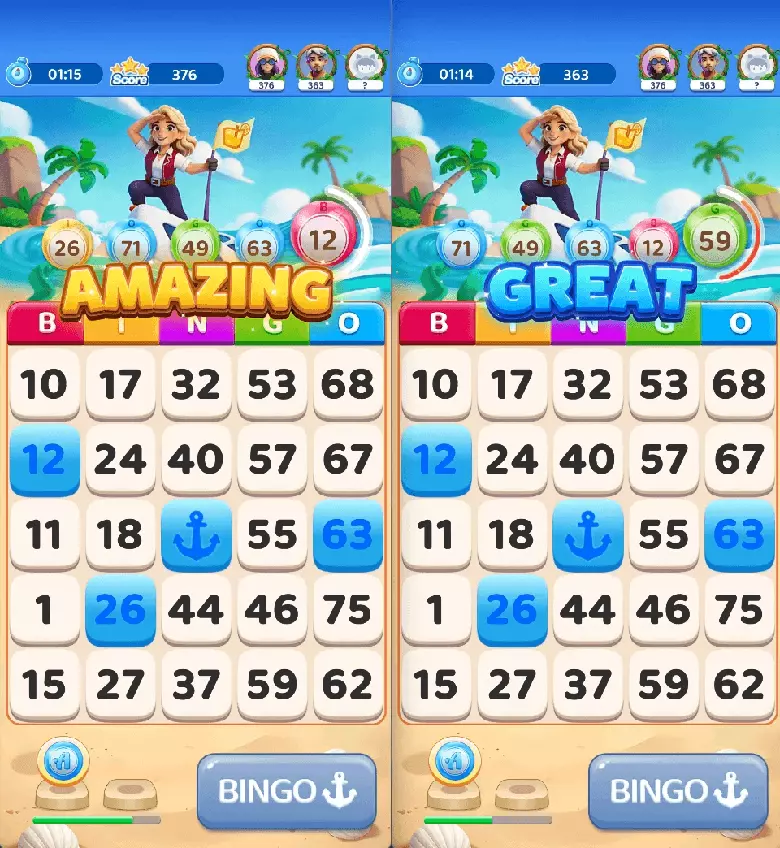
Here’s how it works:
- Before the round starts, the system generates a random ball sequence — 75 numbers in a specific, fixed order.
- Every player in the room receives the same sequence. Player A sees B-4, I-22, N-35, G-58… in exactly that order. Player B sees the exact same order. All 7, 9, or 12 players in the room are working from identical information.
- The calling pace is perfectly consistent. Every ball appears at the same interval. No human variation. No acoustic advantage for players sitting in a specific seat.
- No errors, no corrections. The algorithm doesn’t misread a number. It doesn’t pause awkwardly. It doesn’t need a do-over.
- The sequence is generated before anyone plays, meaning the system itself can’t adjust based on who’s winning or losing.
This is not a minor technical detail. It’s the foundational fairness mechanism that makes skill bingo possible.
Why Identical Sequences Are Non-Negotiable for Skill Bingo
Imagine a skill-based bingo platform where each player received a different random ball sequence. Player A’s board fills quickly because their sequence happens to hit their numbers early. Player B’s board fills slowly because their sequence misses their numbers until the end. Who wins? The luckier player — regardless of daub speed, power-up timing, or strategic decision-making.
That’s not skill bingo. That’s traditional bingo with a digital interface.
BGC’s identical-sequence rule means that if you outscore another player, it’s because you played better, not because the caller gave you friendlier numbers. Two players with identical daub speed, identical power-up usage, and identical decision-making would score identically. Any difference in score reflects a difference in skill execution.
This is the caller’s hidden hand made visible — not through human judgment, but through mathematical rigor.
What the Algorithmic Caller Changes About How You Play
When you know the caller is perfectly consistent and identical for everyone, your strategy shifts in subtle but important ways:
1. Pattern Recognition Becomes Predictable
In traditional bingo, pattern recognition is reactive — you notice a pattern forming after several balls have already been called. In BGC, because the sequence timing is perfectly consistent (90 seconds per round, balls appearing at predictable intervals), you can develop a sense of rhythm for when patterns typically complete.
Most BINGOs happen in the second half of the round. The first 30-40 seconds are for building — daubing scattered numbers and watching patterns take shape. The last 20-30 seconds are where decisions get made: which near-complete pattern to prioritize, when to trigger a Wild Daub, whether to hold a power-up for a Multi-BINGO gambit.
2. Speed Ceilings Are Real and Measurable
With a human caller, speed is relative — you just need to be faster than the caller’s pace. With an algorithmic caller, speed is absolute — the ball appears at a fixed moment, and your daub happens either before the next ball or after it.
The daub scoring window (100–140 points based on speed) is calibrated against the algorithmic caller’s pace. A 140-point daub means you hit the number almost instantly after it appeared. A 100-point daub means you were significantly slower. These numbers don’t lie because the caller’s pace doesn’t vary.
3. Superstition Dies Hard, But It Dies
Traditional bingo players develop dozens of superstitions about callers: “Caller Jim always draws my numbers,” “Caller Susan goes too fast — I can’t win when she’s on.” These feel real because human callers do introduce variance.
With an algorithmic caller, there’s nothing to be superstitious about. The sequence is random. It’s the same for everyone. If you’re losing consistently, it’s not because the algorithm has it out for you — it’s because other players are executing better.
4. Practice Actually Transfers
In traditional bingo, practicing in a different hall with a different caller doesn’t fully prepare you for competition night. The caller’s rhythm, acoustics, and pace are all venue-specific.
In BGC, every room uses the same algorithmic caller. The 50 free rounds you played in Bonus Video this morning prepare you exactly for the Cash Skies room this afternoon. The caller is identical. The timing is identical. Your muscle memory transfers 100%.
The Honest Comparison: Algorithmic Caller vs. Human Caller
| Factor | Human Caller (Traditional) | Algorithmic Caller (BGC) |
|---|---|---|
| Sequence Fairness | Same for all, but human error possible | Identical for all, zero error |
| Pace Consistency | Variable — depends on caller’s mood/energy | Perfectly consistent, 90-second rounds |
| Acoustic Advantage | Players closer to caller hear better | Everyone sees numbers on their screen |
| Error Handling | Subjective — caller discretion | Zero errors — no corrections needed |
| Bias Potential | Human callers can have patterns/preferences | Cryptographically random, pre-generated |
| Skill Measurement | Impossible — caller variance confounds results | Direct — differences reflect player execution |
| Practice Transfer | Venue-specific — different caller, different game | Universal — every room uses the same caller |
The algorithmic caller doesn’t just remove human error — it removes the need to worry about human error. In traditional bingo, part of your mental energy is spent tracking whether the caller is being fair, whether you heard the number correctly, whether the pace is about to shift. In BGC, that mental energy goes entirely toward playing better.
The Bigger Picture: Why Callers Matter to the “Skill vs. Luck” Debate
The algorithmic caller is the quietest but most powerful argument in the “is bingo gambling?” discussion.
Gambling games depend on chance. The outcome of a slot machine pull or a roulette spin is determined by random number generation — your decisions have zero impact. What separates skill gaming from gambling is whether player decisions meaningfully influence outcomes.
In traditional bingo, the human caller introduces uncontrollable variance. Players can make every right decision and still lose because the caller’s pace was off, or the acoustics were bad, or the called number sequence happened to favor someone else’s card layout.
In BGC’s algorithmic bingo, those variables are locked. Same sequence. Same timing. Same board. Same power-ups. The only variable is what each player does with the information they’re given. That’s not gambling. That’s competition.
The algorithmic caller isn’t just a technical feature — it’s the legal and philosophical backbone of skill bingo as a category.
What the Algorithmic Caller Can’t Do (And What That Means for You)
The algorithmic caller provides perfect fairness, but it doesn’t provide strategic guidance. Here’s what the caller won’t tell you:
It won’t tell you which pattern to prioritize. The caller delivers numbers. Your job is to recognize patterns, track which ones are closest to completion, and make decisions about where to focus your attention.
It won’t tell you when to use power-ups. The caller shows the ball. You decide whether this is the right moment for a Wild Daub, whether the Double Score window is wide enough to be worth triggering, whether it’s time to convert Pick-A-Ball into a BINGO finisher.
It won’t tell you if you’re making errors. The caller doesn’t warn you when you daub the wrong number. Error avoidance is entirely on you — and at −25 points per error daub and −100 points per error BINGO, it’s one of the costliest skill gaps in the game.
The algorithmic caller creates the conditions for a fair competition. Everything after that — winning, losing, improving — is on the player.
How to “Read” the Algorithmic Caller (Without Superstition)
Advanced BGC players develop a relationship with the algorithmic caller that’s less about superstition and more about pattern anticipation:
Early-round scanning (first 15 seconds): As balls appear, mentally note which of the 4 pattern types (Horizontal, Vertical, Diagonal, Four Corners) is developing fastest. The caller’s sequence is random, but patterns emerge from any random sequence — your job is to spot them first.
Mid-round triangulation (15–45 seconds): Once 20+ balls have been called, you should have a clear sense of which pattern is closest to completion. Start calculating: “I need 3 numbers for this Vertical, 4 numbers for this Diagonal. The Vertical is the priority.”
Late-round execution (45–90 seconds): This is where the algorithmic caller’s consistency becomes your ally. You know exactly how much time is left. You know approximately how many balls remain. Your decisions — hold the power-up or use it now? Go for the safe single BINGO or gamble on the Multi-BINGO? — are made against a perfectly predictable clock.
Post-round analysis: After each round, mentally replay your decisions. Did you call the right pattern? Did you trigger a power-up too early or too late? The algorithmic caller’s consistency means that if you replayed the exact same round with different decisions, your score would change predictably. This makes post-game analysis meaningful in a way that traditional bingo can never match.
FAQ: Common Questions About Bingo Callers
Q: Does Bingo Gold Cash use a real person as the caller?
A: No. BGC uses an algorithmic caller — a predetermined, randomized ball sequence generated before each round. All players in a room see the same sequence at the same pace, eliminating every fairness concern associated with human callers.
Q: Can the algorithmic caller be rigged against certain players?
A: The sequence is generated before the round starts — before anyone has taken a single action. Because it’s the same sequence for all players and can’t be modified mid-game, it’s mathematically impossible to rig against specific individuals. If the caller were biased, it would have to be biased against everyone equally, which is logically equivalent to being unbiased.
Q: Does the caller’s pace affect my daub score?
A: Yes — but consistently for everyone. Daub scoring (100–140 points) is based on how quickly you tap after a number appears. The algorithmic caller delivers numbers at a perfectly consistent pace, so your speed score reflects your reaction time, not a variable caller rhythm.
Q: Can I predict which numbers the caller will announce next?
A: No — and that’s by design. The sequence is randomly generated. Any attempt to predict specific numbers is superstition. What you can predict is which patterns are forming based on the numbers that have already been called — that’s pattern recognition, and it’s a genuine skill.
Q: Why doesn’t BGC have a human caller with fun number rhymes?
A: Entertainment value is real — traditional caller rhymes (“Legs Eleven” for 11, “Two Little Ducks” for 22) are part of bingo culture. But BGC prioritizes competitive integrity over theatrical presentation. When real money is on the line, a perfectly fair algorithmic caller beats a charming but variable human caller every time.
The Verdict: The Best Caller Is the One You Never Notice
The highest compliment you can pay to a bingo caller is that you forgot they existed. In traditional halls, that’s almost impossible — the caller is the center of attention, the voice everyone tracks, the variable everyone secretly worries about.
In Bingo Gold Cash, the bingo caller recedes into the background. Numbers appear. You daub them. Patterns form. You make strategic decisions. The caller doesn’t distract, doesn’t vary, doesn’t favor anyone. It just works — and in that invisibility lies its genius.
When the caller never makes a mistake, never changes pace, and never gives one player an acoustic advantage over another, the only thing left to determine the outcome is how well you play. That’s not just good game design. It’s the entire point of skill bingo.
The algorithmic caller isn’t a downgrade from the human version. It’s an upgrade — from entertainment to competition, from luck to skill, from hoping the caller likes you to knowing your score reflects your ability. And once you’ve played with a caller that’s perfectly fair, you’ll never look at a human caller the same way again.
⬇️ Download Bingo Gold Cash — Free on iOS & Android
Related Articles in This Series:
- What Is Skill Bingo? The Complete 2026 Guide
- What Is a Daub in Bingo? The Complete Guide to Bingo Daub Mechanics, Speed & Accuracy (2026)
- Is Bingo Gambling? The Legal Truth About Skill Gaming in 2026
- Bingo Rules in 2026: The Skill-Based Bingo Rulebook Every Player Needs
- Bingo Scoring Strategy: How to Score Higher & Win More Cash in Skill-Based Bingo 2026
External Links: