Bingo Strategy Guide 2026: Power-Ups, Scoring & How to Win Consistently
Author: Zenith Games Team | Category: Tips & Strategy | Reading Time: 7 minutes | Last Updated: May 2026
Most bingo strategy articles give you advice designed for a different game — card selection tactics, multi-card management, probability theory based on game length. None of that applies to modern skill-based bingo, where every player shares the exact same board, ball sequence, and power-up sequence.
This bingo strategy guide 2026 is built for the game as it actually works: a 90-second, single-card, skill-based format where winning comes down to daub speed, power-up timing, and strategic decision-making under pressure. If you have already read our rules and patterns guide, you know the basics. This article covers how to win.
Table of Contents
- Power-Ups: Your Strategic Arsenal
- How Scoring Works: Where Speed Meets Reward
- 6 Proven Strategies for Skill-Based Bingo
- Frequently Asked Questions
Power-Ups: Your Strategic Arsenal
Power-ups are the single highest-impact strategic element in Bingo Gold Cash. They are earned by filling your booster gauge through fast, accurate daubing. You can hold up to three at a time. The difference between a player who deploys power-ups at random and one who follows a phase-based framework is often the difference between cashing and watching.
The Four Power-Ups
| Power-Up | Effect | Best Used When… |
|---|---|---|
| Wild Daub | Daub any number on your card — your choice | You are one cell away from completing a pattern and the ball you need has not appeared |
| Pick-A-Ball | Get the exact ball you need — the number appears and you daub it | A specific corner or diagonal cell is the only thing between you and a BINGO |
| Double Score | ×2 points on all daubs and BINGOs for 10 seconds | You have 2–3 patterns close to completion and can daub rapidly for the full 10-second window |
| Bonus Time | Extends the round by 10 seconds + grants 3 extra balls | You are mid-leaderboard with a nearly complete Full House — the extra time can flip the rankings |
Phase-Based Deployment Framework
The game clock is your deployment guide. Every 90-second round breaks into three phases:
Phase 1 — Early Game (0–30 seconds): Double Score Window
Deploy Double Score as early as possible if you have it. Early game has the highest daub frequency — balls are appearing rapidly and your card has the most unmarked numbers. The ×2 multiplier on 140-point daubs means every tap earns 280 points. An early Double Score window can build a 1,000+ point lead before anyone else has finished their first pattern.
Exception: If you do not have many matching numbers on the current ball sequence, hold Double Score until a cluster of your numbers appears. Wasting half the window on 1–2 daubs is a common beginner mistake.
Phase 2 — Mid Game (30–60 seconds): Precision Power-Ups
This is where Wild Daub and Pick-A-Ball shine. Patterns are forming. You are 1–2 cells away from a BINGO on one or more patterns. The decision tree:
- If one cell away from a diagonal or corner pattern: Use Pick-A-Ball. Corner numbers and diagonal endpoints are the least likely to appear naturally — do not wait for them.
- If one cell away from a horizontal or vertical line: Consider holding Wild Daub for a bigger opportunity. Lines complete more frequently through natural ball calls.
- If two patterns are both 1–2 cells away: Save both Pick-A-Ball and Wild Daub. This is a Multi-BINGO setup — completing both patterns before hitting BINGO is worth far more than calling them separately.
Phase 3 — Late Game (60–90 seconds): Full House Chase
Bonus Time is most valuable here. If you are within 3–4 cells of a Full House (10,000 points), deploying Bonus Time for 10 extra seconds and 3 more balls can flip a mid-pack finish into first place. The risk: another player calls BINGO and the round ends while you are still chasing. Gauge the leaderboard — if you are in 3rd–5th place and 2,000+ points behind 1st, a single BINGO will not close the gap. The Full House gamble is your best play.
Power-Up Holding Strategy
You can hold up to three power-ups simultaneously. The ideal hand entering the mid-game:
- Pick-A-Ball (for the clutch moment)
- Wild Daub (for the backup pattern)
- Double Score or Bonus Time (depending on board state)
Never waste a power-up slot on something you do not intend to use. If your booster gauge is about to max and you are already holding three, deploy the least situationally valuable one to make room — even if it is not the “perfect” moment. A wasted power-up earned is worse than a sub-optimally timed deployment.
How Scoring Works: Where Speed Meets Reward
Understanding the scoring math is not optional if you want to win consistently. Every decision — when to daub, when to use a power-up, when to call BINGO — is a scoring calculation.
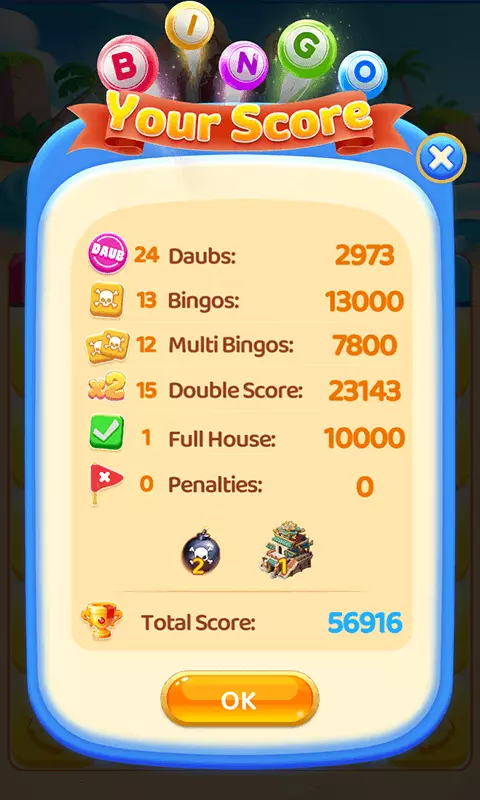
Full Scoring Table
| Action | Points | Notes |
|---|---|---|
| Daub (fast) | 140 | Tap within the first ~1 second of the ball appearing |
| Daub (medium) | 120 | Standard response time |
| Daub (slow) | 100 | Late tap, near the end of the ball display window |
| BINGO (single) | 1,000 | One pattern completed |
| Multi-BINGO | 1,000+ × multiplier | Multiple patterns completed before hitting BINGO — the more patterns, the higher the score |
| Full House | 10,000 | All 24 numbered cells marked — the maximum single-event score |
| Error Daub | -25 | Tapping a number not yet called — avoid at all costs |
| Error BINGO | -100 | Hitting BINGO without a completed pattern — costly mistake |
The Compound Effect of Daub Speed
In a typical 90-second round with ~35 ball calls, a fast daub rhythm (140 pts per tap across 30 successful daubs) yields 4,200 points from daubing alone. A slow rhythm (100 pts per tap) yields 3,000 points. That 1,200-point gap — before any BINGOs or power-ups — wins or loses rooms.
Multi-BINGO vs. Safe BINGO: The Math
- Single BINGO: 1,000 points
- Double BINGO (two patterns completed): ~2,000–2,500 points
- Triple BINGO: ~3,000–4,000 points
- Full House: 10,000 points
The question in every round: is the extra 1,000–3,000 points from waiting for a Multi-BINGO worth the risk of someone else calling first?
Decision framework:
| Situation | Action |
|---|---|
| You are 1st–2nd place, < 15 seconds left | Hit BINGO immediately — lock in the win |
| You are 3rd–5th place, > 20 seconds left, two patterns near completion | Wait for Multi-BINGO — a single BINGO will not catch the leader |
| You are within 3–4 cells of Full House, holding Bonus Time | Chase Full House — the 10,000-point payout is worth the gamble |
| You have no power-ups, patterns are not clustered | Hit BINGO at first opportunity — do not get greedy without the tools to back it up |
6 Proven Strategies for Skill-Based Bingo
Traditional bingo strategy articles talk about card selection (Granville’s method) and game-length probability (Tippett’s theory). Those concepts are irrelevant here — in Bingo Gold Cash, every player shares the same card and the same ball sequence. There is no card to “choose” and no probabilistic edge from number distribution. Here is what actually works.
Strategy 1: Train Your Daub Speed
Daub speed is the single largest controllable factor in your score. Every tap earns 100–140 points depending on speed, and the difference compounds across 30+ daubs per round.
Training drill: Play 5 consecutive free-entry rounds focusing exclusively on daub speed. Do not worry about patterns. Do not worry about winning. Just tap as fast as you can. Track your average daub score per round. Aim to move from the 100–110 range to the 130–140 range. Once speed is muscle memory, layer pattern awareness back in.
Strategy 2: Pre-Scan Your Card Before Every Round
During the 3-second pre-game countdown, run this mental checklist:
- Identify all four corners — they are independent of the main grid
- Trace both diagonals — both pass through the FREE space
- Note which rows are missing only 1–2 numbers at the start (row 3 is inherently closer to completion due to the FREE space)
- Check the N column — needs only 4 called numbers instead of 5
This takes two seconds. It pays off across the entire round because your brain has already mapped the high-probability zones before the first ball appears.
Strategy 3: Power-Up Timing Is Everything
As covered in the Power-Ups section, the deployment sequence matters:
- Double Score early — maximize daub frequency during the multiplier window
- Pick-A-Ball and Wild Daub mid-game — for pattern-completion precision
- Bonus Time late — for Full House chases
The most common mistake: burning Pick-A-Ball immediately upon earning it to complete a single horizontal line, when waiting 15 more seconds could have secured a diagonal BINGO or Multi-BINGO instead.
Strategy 4: The Multi-BINGO Gambit
When you have two patterns 1–2 cells away from completion, do not hit BINGO for the first one. Daub aggressively, use saved power-ups to close the second pattern, and then hit BINGO for a Multi-BINGO multiplier.
When to take the risk: You are in 3rd–5th place with 25+ seconds remaining. A single BINGO (1,000 pts) cannot reach 1st. A double or triple BINGO might.
When to play safe: You are in 1st or 2nd place with less than 15 seconds left. Lock in the payout. Do not gamble a guaranteed win.
Strategy 5: Avoid Error Penalties
Error daubs (-25) and error BINGO calls (-100) are the silent score killers. In a close tournament where the gap between 3rd and 5th place is often under 200 points, three error daubs knock you out of the money.
Train accuracy before speed. A clean, medium-speed round consistently outscores a fast-but-sloppy one. Once you stop making errors, push the speed envelope.
Strategy 6: Use the Leaderboard
The live leaderboard is not just a score display — it is real-time strategic intelligence. Check it at 30 seconds, 60 seconds, and whenever you are considering a BINGO call. Ask:
- How far am I from the payout cutoff (e.g., 5th place in Bingo Match)?
- Is the gap to 1st place closeable with a single BINGO, or do I need a Multi-BINGO or Full House?
- How many players are clustered within 500 points of me? (If the field is tight, every daub counts.)
The players who ignore the leaderboard make decisions blind. The players who use it make decisions informed.
Frequently Asked Questions
Q1: How many points do I need to win a bingo game?
There is no fixed “winning score” — it depends on the room and the competition. As a benchmark: a clean round with fast daubing (130+ avg), one Double Score window, and a single BINGO typically produces 6,000–8,000 points. A Multi-BINGO round can push past 10,000. A Full House round (10,000 just for the Full House) can exceed 15,000.
Q2: Which power-up is the most valuable?
Context-dependent, but Double Score has the highest theoretical ceiling — a well-timed 10-second window during a daub cluster can produce 1,500–2,000 bonus points. Pick-A-Ball has the highest clutch value — it can secure a BINGO that would otherwise be impossible. Bonus Time has the highest comeback potential — 10,000-point Full Houses only happen with extra time.
Q3: Is it better to daub fast or daub accurately?
Accuracy first, then speed. A clean round with 120-point daubs beats a sloppy round with 140-point daubs and three error penalties (-75 points). Build accuracy to 100%, then push speed incrementally.
Q4: Can I really earn consistently playing skill-based bingo?
Yes — that is the entire point of the skill-based model. If outcomes were random (like traditional bingo), consistent earnings would be impossible. Because every player shares the same board, same balls, and same boosters, the player with better daub speed, smarter power-up timing, and sharper strategic decisions wins more often. Over a large sample of rounds, skill dominates variance.
Q5: How do Multi-BINGO scores actually work?
When you complete a pattern, the BINGO button lights up. If you wait and complete additional patterns before pressing it, the score multiplies. For example: completing a horizontal line (1,000 pts) while a vertical line is also complete might award 2,200+ points instead of 2,000 for two separate BINGOs. The exact multiplier depends on the number of simultaneous patterns. The maximum is a Full House (all 24 numbers) at 10,000 points.
Q6: What is the single biggest mistake new players make?
Hitting BINGO too early. New players see the button light up and press it immediately, collecting 1,000 points. Meanwhile, a player who waits 10 more seconds, completes a second pattern with a well-timed Pick-A-Ball, and calls a double BINGO earns 2,500+ points. The 1,500-point gap is the difference between 4th place and 1st in many rooms.
From Here: What’s Next
This bingo strategy guide 2026 covered the tactical layer: power-ups, scoring math, and the six strategies that separate consistent winners from the pack. Two companion articles complete the picture:
| If you want to learn… | Read this |
|---|---|
| Card anatomy, the 4 winning patterns, step-by-step round guide, and bingo terminology | ← Bingo Complete Guide 2026: Rules & Patterns |
| Room types, entry fees, prize structures, withdrawal mechanics, and how to pick the best room for your skill level | → Bingo Gold Cash Rooms & Real Money Guide |
Ready to Play?
The strategies in this guide are not theory — they are trainable skills. Download Bingo Gold Cash, jump into a free-entry room, and spend five rounds focusing on just one thing: daub speed. Once 130+ daubs feel automatic, layer in the power-up framework. Then the Multi-BINGO gambit. Then the leaderboard reading. One skill at a time.
Strategy works — but only if you practice it. Download Bingo Gold Cash and put these tactics into your next round.
Related Articles:
- How to Win Real Money in Bingo Gold Cash Without Spending
- Bingo Gold Cash Review (2026): Play Bingo, Win Real Money — Here’s the Truth
- Bingo Gold Cash Player Types: 6 Distinct Personalities That Define Your Game
- The Most Reliable Cash Bingo Game of 2026
- Play Styles: Discover Your Unique Nature | NIFPlay